
Go 1.24 is set to be released in February 2025, bringing with it a host of improvements in performance, tooling, language features, cryptography, and runtime enhancements. This blog post serves as an introduction to the key updates, providing an overview before diving into specific changes in future posts.
Why Upgrade to Go 1.24?
With Go 1.24, developers can expect:
- Performance improvements: Swiss table-based maps and optimized runtime internals lead to faster execution.
- Better tooling: JSON support for
go buildandgo test, new dependency tracking with tool directives, and enhancements togo vet. - Security upgrades: New cryptographic packages (
crypto/mlkem,crypto/hkdf,crypto/pbkdf2,crypto/sha3) and FIPS 140-3 compliance. - Language enhancements: Full support for generic type aliases, reducing redundancy in complex codebases.
- Testing enhancements: The new
testing.B.Loopfunction simplifies benchmark iteration, and thetesting/synctestpackage helps test concurrent programs more effectively. - Filesystem security improvements: The
os.Roottype enables directory-limited filesystem access, enhancing security in containerized and sandboxed environments.
1. Language Enhancements
Generic Type Aliases
Go 1.24 now fully supports generic type aliases, allowing type aliases to be parameterized, similar to defined types. This improves code reusability and simplifies generic programming.
Example: Generic Type Aliases
type List any
Previously, generics required explicit definitions, but now type aliases can be used directly, making code more maintainable.
2. Performance Improvements
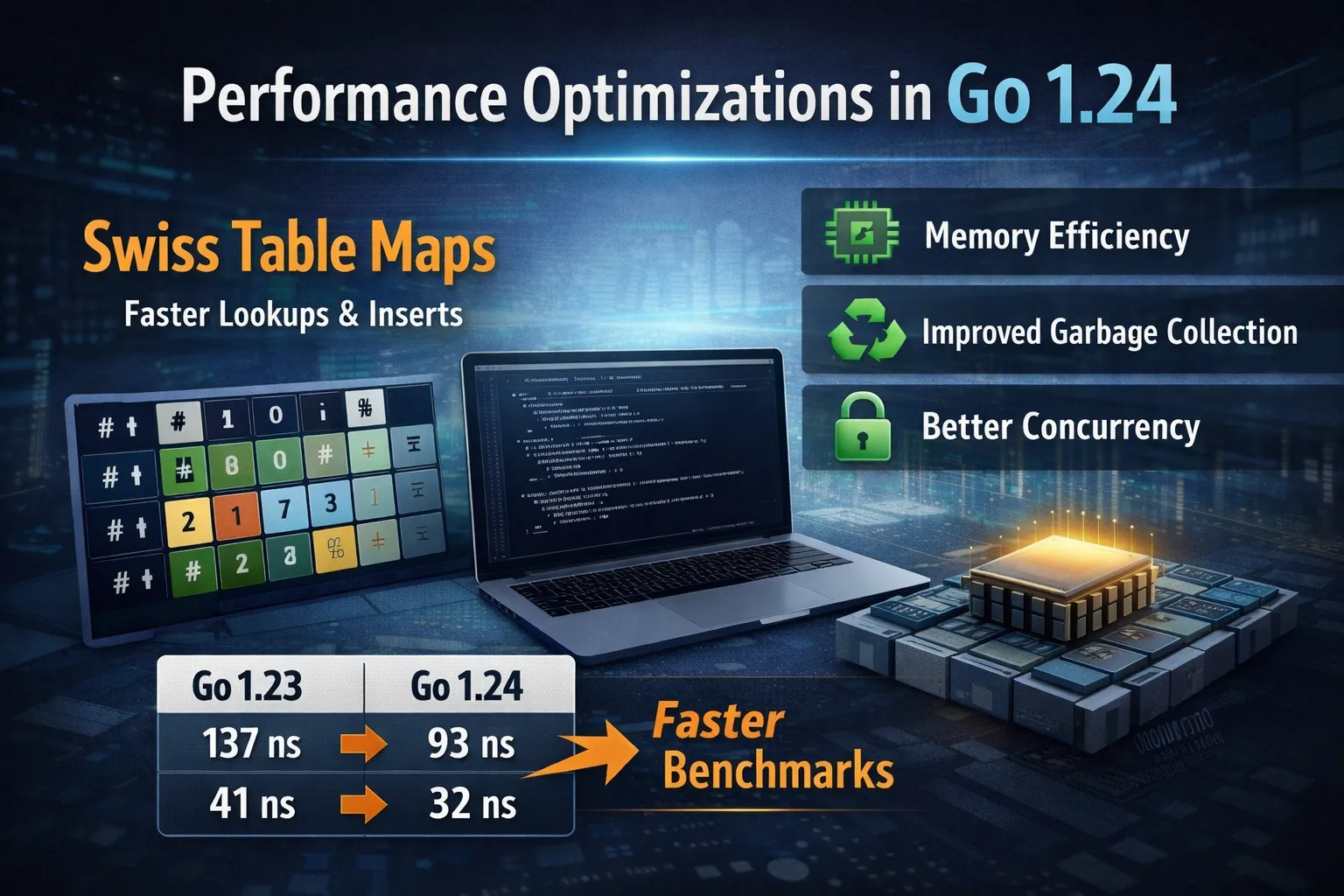
Go 1.24 introduces Swiss Tables for map operations, leading to significant performance gains. With this, we should see measurable improvements, especially for large datasets.
Faster Compilation and Optimized Code Generation
- Better register allocation: Reduces redundant memory accesses.
- Faster function inlining: Reduces function call overhead.
- More efficient stack frame layout: Improves function calls and memory usage.
Measuring Compilation Time Improvements

3. Security and Cryptography Updates
Go 1.24 strengthens security with:
- New
crypto/mlkempackage: Implements post-quantum cryptography standards (ML-KEM-768 and ML-KEM-1024). - New hashing and key derivation functions:
crypto/hkdf,crypto/pbkdf2,crypto/sha3. - FIPS 140–3 compliance: New
GOFIPS140environment variable ensures cryptographic compliance.
4. Testing Improvements
New testing.B.Loop for Benchmarks
The traditional b.N loop can be error-prone due to several reasons:
- Incorrect Use of
b.Nin Setup Code: Expensive setup operations insidefor i := 0; i < b.N; i++can skew benchmark results. - Loop Iterations Not Scaling Well: Large
b.Nvalues may distort results. - Optimization by the Go Compiler: The compiler may optimize away computations inside
b.Nloops. - Inconsistent Iteration Control:
b.Ndynamically increases, which can affect consistency.
Why b.Loop() is Better
According to Go issue #61515, b.Loop() provides:
- Automatic iteration control
- Proper setup and clean-up handling
- More predictable benchmarking
Example:
func BenchmarkMyFunction (b *testing.B) {
	for .Loop () {
		MyFunction () } }
for .Loop () {
MyFunction () } }
testing/synctest for Concurrent Testing
The synctest.Run function enables better testing of concurrent code:
package main
import ( "testing" "testing/synctest" ) func TestConcurrent (t *testing.T) {
	synctest.Run(t, func {
		someConcurrentFunction() synctest.Wait() }) }
import ( "testing" "testing/synctest" ) func TestConcurrent (t *testing.T) {
synctest.Run(t, func {
someConcurrentFunction() synctest.Wait() }) }
5. Tooling Enhancements
JSON Support for go build and go test
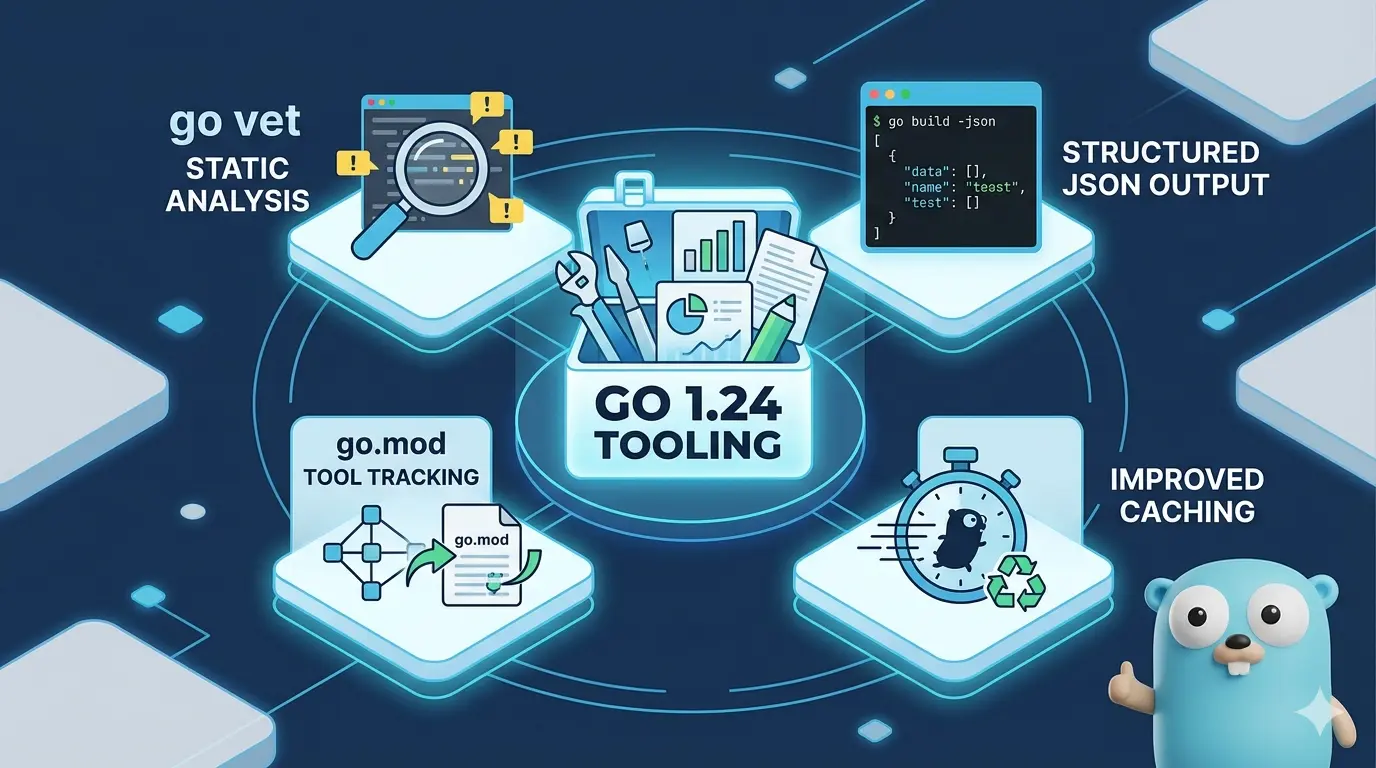
The -json flag now provides structured output, making it easier to integrate with CI/CD pipelines and debugging tools.
go build -json ./...
go test -json ./...
New tool Directives for Dependency Management
Go modules can now track executable dependencies directly using tool directives in go.mod, eliminating the need for tools.go files.
go get -tool golang.org/x/tools/cmd/stringer
Alternatively, tools can be directly added to go.mod:
tool golang.org/x/tools/cmd/stringer
6. Garbage Collection Enhancements
Go 1.24 improves garbage collection (GC) performance by lowering GC overhead, optimizing large object handling, and ensuring more predictable latency. These optimizations result in better memory management, reducing the impact of GC pauses in high-performance applications.
Final Thoughts
Go 1.24 is a major step forward, providing performance boosts, security hardening, and developer-friendly enhancements. Over the course of this series, we’ll explore these features in-depth, providing code examples, performance benchmarks, and migration tips.
Stay tuned for the next post, where we dive deep into Go 1.24’s generic type aliases and how they simplify code maintenance.
This post is a part of a series, where we delve deeper into Go 1.24. Each entry builds upon the last. Be sure to explore the entire series to get the full picture.
- Introduction to Go 1.24: What’s New and Why It Matters
- Exploring Generic Type Aliases in Go 1.24
- Performance Optimizations in Go 1.24: Swiss Table Maps and More
- Secure Filesystem Access in Go 1.24: Introducing
os.Root - Improved Finalization in Go 1.24: Introducing
runtime.AddCleanup - Memory Efficiency in Go 1.24: Introducing the
weakpackage - Advanced Concurrency Testing in Go: Exploring the experimental
testing/synctest - Enhancements to Go Tooling in 1.24:
go vet,go buildand More