Skip to main content

For a US digital pharmacy offering same-day prescription delivery, fulfilling a prescription involved continuous coordination between doctors, clinics and pharmacy teams.
Doctors needed to know whether prescriptions had been received, whether insurance approval was pending and when medication would reach their patients. Pharmacy Account Managers (AMs) were responsible for coordinating with clinics, following up on missing information and helping prescriptions move towards fulfilment.
But much of this coordination happened through phone calls, emails and Microsoft Teams.
Doctors had no direct visibility into prescription progress. When insurance documents were missing or prior authorisation was required, AMs had to contact the relevant doctor or clinic. Information was exchanged across different channels, without a common place to track prescription status.
The pharmacy wanted to create a more connected experience, giving clinicians direct access to prescription information while reducing dependence on manual communication.
The longer-term ambition was to consolidate communication between clinics and the pharmacy within a single digital platform.
Technogise worked with the client on early discovery and solution design, then built and launched the Doctor's App, a B2B portal connecting partner clinics, doctors and pharmacy Account Managers.
The application brought together patient information, prescriptions, insurance coverage and delivery updates.
Doctors and clinic staff could check the status of their patients' prescriptions directly, while AMs gained a central view of the clinics, providers and prescriptions they managed.
The application was designed around an important principle: the right healthcare professional should have access to the right information, within the right clinical context.
Delivering this required more than creating a dashboard. It meant understanding the relationships between doctors, hospitals, clinic staff, patients and pharmacy teams, and translating those relationships into an appropriate access model.
One of the most challenging aspects of the engagement was establishing how patient information should be accessed across different healthcare facilities and roles.
A doctor might practise at multiple hospitals, each with different support teams. The same patient could be associated with that doctor across facilities, but this did not mean every member of staff should have identical access to the patient's information.
Consider a doctor practising at two hospitals.
At the first hospital, the doctor works with one group of support staff. At the second, the same doctor works with a different team. Even when the patient is the same, the access available to support staff must reflect their responsibilities and the facility within which they operate.
Pharmacists, meanwhile, require a different prescription view to support fulfilment.
This made access design a question of clinical relationships and context, not simply user roles.
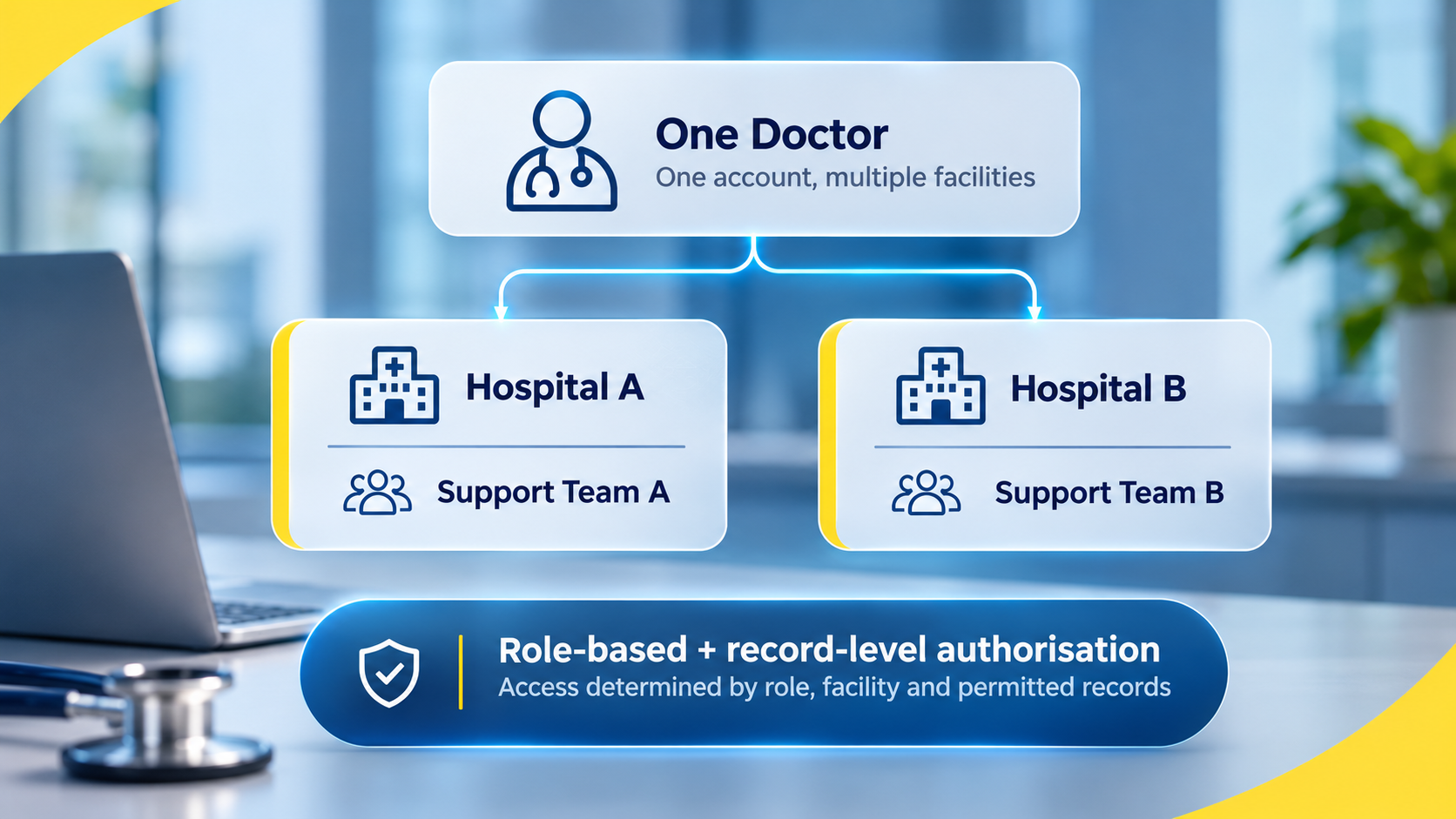
Technogise worked with the client to establish a three-level hierarchy of groups, facilities and users, supported by role-based and record-level authorisation.
The model accounted for several real-world requirements:
The resulting application implemented role-based permissions and record-level controls to restrict access to appropriate patient, prescription and facility information. The more detailed hospital-specific access scenarios also informed the team's design considerations.
The Doctor's App gave doctors and clinic staff a shared place to access information that had previously required repeated communication with the pharmacy.
Doctors could see the progress of prescriptions from receipt through insurance approval to delivery.
Instead of contacting an AM to ask whether a prescription had been processed or dispatched, they could access the latest available status through the portal.
Clinic staff could also follow up on prescriptions associated with their facility, allowing routine coordination to continue without depending entirely on the prescribing doctor.
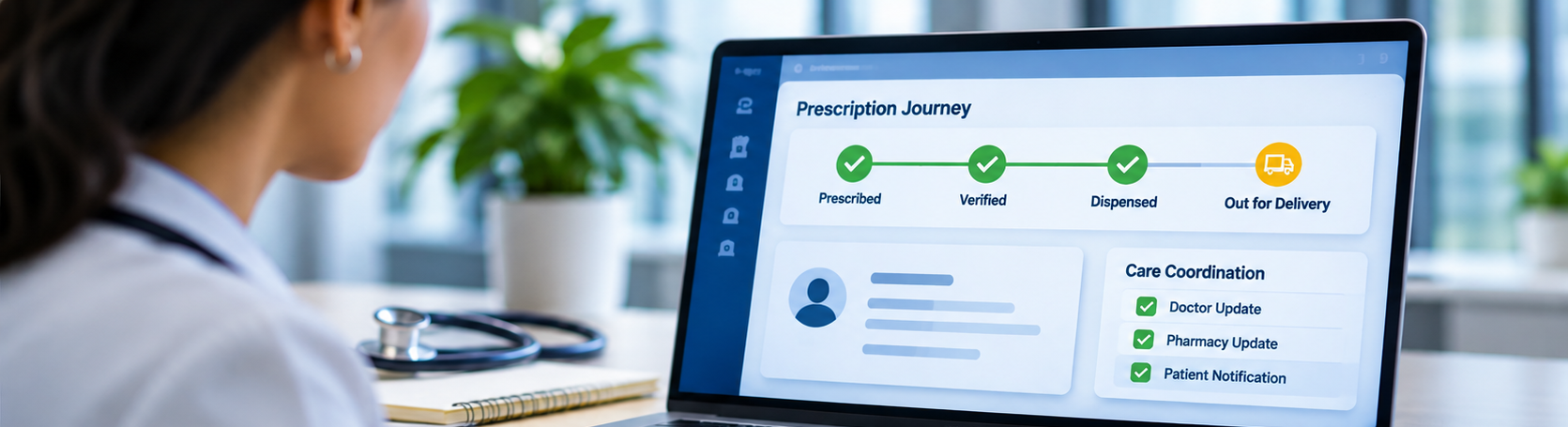
The portal brought patient details, prescriptions and insurance coverage into one view.
This helped doctors understand the patient's prescription information and identify medication options that the patient's insurance would approve.
Doctors could also see prescriptions written by other doctors for patients they had prescribed for, supporting greater continuity of information across care relationships.
For AMs, the application brought clinic relationships and associated prescriptions into one place.
AMs could onboard clinics and doctors directly. When a doctor was added, the application automatically created the account and sent a welcome email.
Each clinic had a defined AM relationship, with an AM Admin available as backup. Incoming prescriptions were associated with the relevant clinic and provider, reducing the need for manual sorting and making ownership clearer.
These capabilities also established the foundation for request-information workflows developed subsequently by other teams.
The portal needed to reflect the information held in the pharmacy's operational systems without requiring duplicate data entry. Technogise built event-driven integrations with PrimeRx, the pharmacy management system, and the existing Delivery App. Listeners captured prescription and patient insert and update events from PrimeRx and streamed them through AWS Kinesis to the application's backend services.
A separate listener captured delivery status changes, allowing doctors and AMs to follow prescription progress through the portal. The team also addressed changes to existing prescription records, including updates to patient and prescriber information. Incoming prescriptions were associated with the appropriate clinic using the prescriber's address, with the pharmacy's NPI retained as part of the prescription information.
The architecture used three backend services accessed through an API Gateway, with Okta handling identity management. This approach allowed the Doctor's App to work with existing systems rather than replacing them, while making their information accessible through a connected user experience.
Because the application handled protected health information, access control was central to its design.
Technogise implemented separate permissions for doctors, clinic staff, clinic administrators, AMs and AM Admins.
Record-level authorisation ensured that patient, prescription and facility endpoints returned only information the user was entitled to access. The application used Okta for authentication and supported different login arrangements for pharmacy and clinic users. The portal brought together seven categories of healthcare information, including prescriptions, patients, insurance, delivery status, providers, clinics and pharmacy identifiers.
The team also had to account for US healthcare requirements, including NPI rules, prescriber and non-prescriber distinctions, prior authorisation and patient identity matching. Importantly, insurance claims exchange and prior authorisation processing remained outside the Doctor's App. The portal displayed the resulting prescription statuses, giving clinicians visibility without duplicating those underlying processes.
Technogise was involved in early product discovery and solution design, including shaping the clinic and user model. As the engagement progressed, the team continued to contribute through engineering delivery, identifying risks and recommending alternative approaches where appropriate.
The engagement required collaboration across product, engineering, quality assurance and DevOps, alongside an understanding of healthcare operations and the practical realities of clinical access.
The work was not simply about implementing a predefined interface. It involved translating complex healthcare relationships into a secure, usable application connected to live operational systems.
The Doctor's App created a shared digital foundation for prescription visibility and coordination between clinics and the pharmacy.
The Doctor's App moved prescription visibility towards a more connected digital experience, giving doctors and clinic staff direct access to information that previously required repeated enquiries.
While consolidating communication across channels remained a longer-term ambition, Technogise delivered an important foundation for that change: a working clinician portal integrated with existing pharmacy systems, supported by healthcare-specific access controls and a shared view of prescription progress.