The client is a leading consumer fintech in India running several distinct product lines. Its product teams build fast for mobile-first users, while the business it sits inside coordinates with banks, non-banking financial companies, and national payment bodies that move on their own release cycles and approval gates.
Those two pressures met in the engineering work: reliable workflow execution for marketing and transactional notifications at scale, channel-specific correction when a message went out wrong, configurable support flows that did not need an engineer for every new scenario, device management tied to fraud detection, and payments products requiring coordination across internal platform teams and external regulated parties.
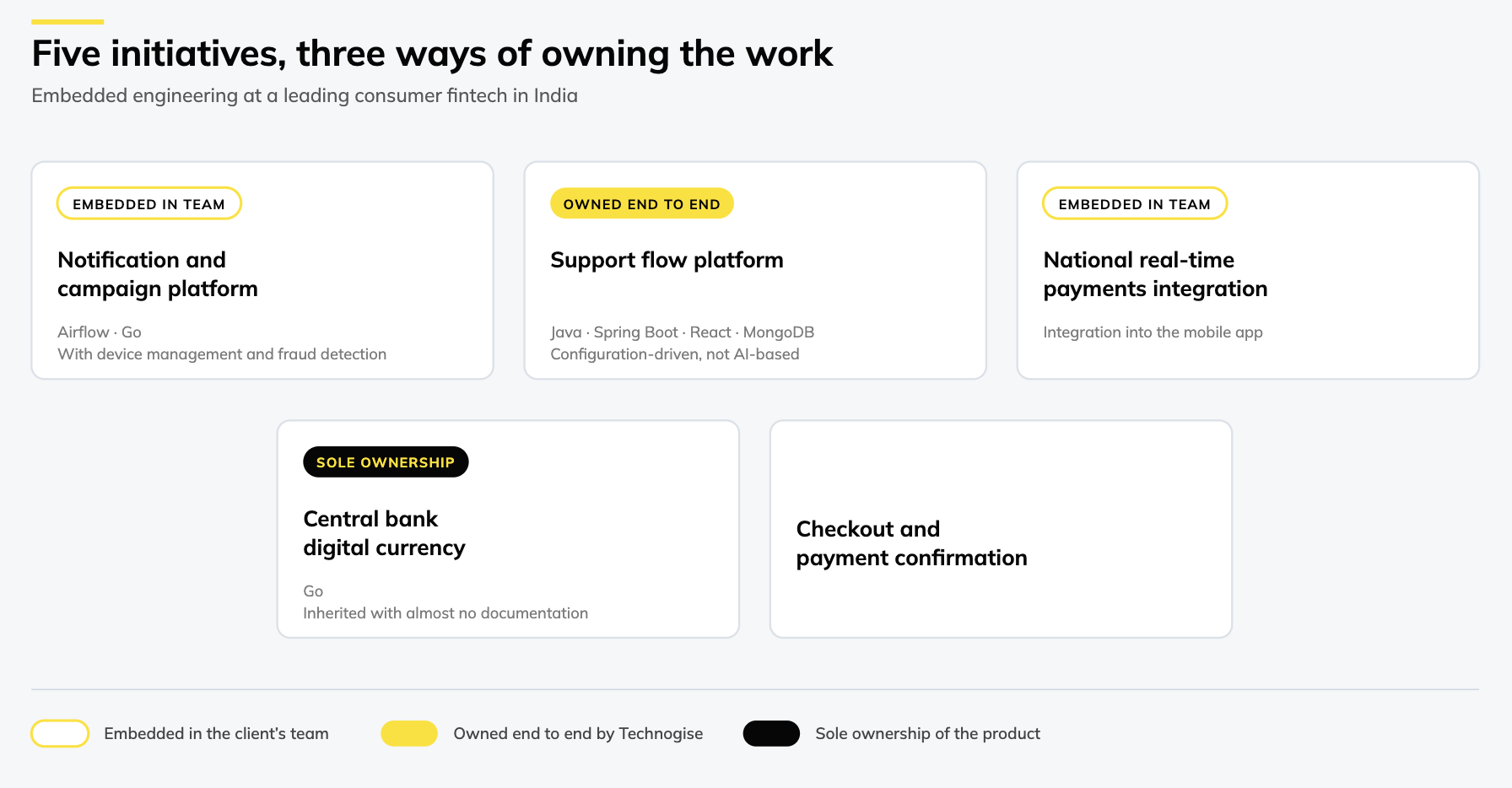
The Technogise team embedded with the existing team building the notification and campaign platform, working alongside the Product Manager, the Engineering Manager, and in some cases end customers.
The platform supported marketing campaigns, user segmentation, transactional notifications, and promotional notifications. The marketing team depended on these services to reach users, which made reliability the dominant concern.
It ran on a Directed Acyclic Graph architecture for data pipelines and workflows, supporting reusable pipelines for promotional messaging to specific user cohorts, implemented with Airflow and Go. The DAG model suits campaign orchestration because campaigns break naturally into dependent stages: identify a cohort, apply segmentation, prepare message context, dispatch through the relevant channel. Making those dependencies explicit also made the pipelines reusable rather than rebuilt per campaign.
Message correction was the harder problem. Once a message leaves the platform, the system no longer has uniform control over it. Some channels allow a message to be recalled, edited, or superseded. Others are irreversible on delivery, which means correction has to happen through a follow-up on that channel or another one entirely. Correction behaviour had to match delivery behaviour per channel. In fintech, incorrect customer communication carries a cost in user trust and generates operational follow-up for support, product, and marketing at the same time.
The same engagement covered device management for the mobile app: the module responsible for identifying fraudulent transactions and fraudulent use of the app. In Indian consumer fintech this sits close to risk, because a payment experience depends on more than processing a transaction correctly. The application has to reason about the integrity of the device and the legitimacy of the usage pattern behind it.
Technogise owned the customer support flow platform end to end, from analysis through development. It is configuration-driven rather than AI-based. Support teams design flows as a tree structure with multiple nodes, conditions, and branching logic, and the platform executes different paths dynamically based on user responses. A backend application gives support teams the interface to create and manage flows, and Technogise extended the platform with custom nodes for business-specific requirements. Built with Java, Spring Boot, React, and MongoDB.
Support scenarios across the client's product lines changed constantly. A configuration surface that support staff can operate keeps engineering out of the path for routine changes, while the node model keeps the system structured enough that new requirements do not turn into bespoke development each time.
The second engagement moved into payments directly.
One initiative put the Technogise team on an integration with India's national real-time payments network into the mobile app, a product area where the consumer journey depends on coordination across app, backend, payment rails, and external ecosystem participants.
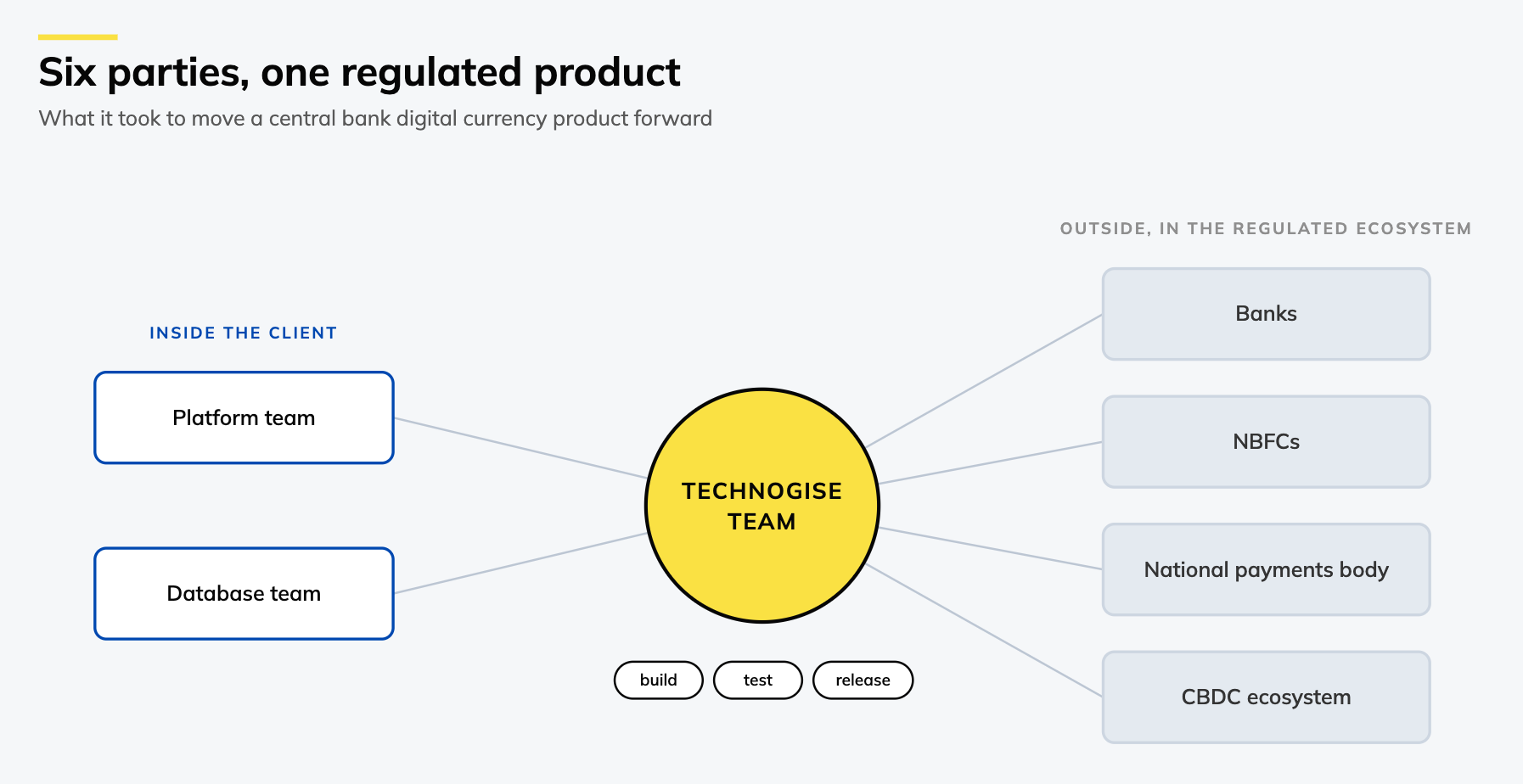
The central bank digital currency work was the sharper test. The Technogise team took over the product when the last remaining developer on the team left, inheriting almost no documentation. The client wanted to run lean, so building, testing, and releasing all sat with Technogise, written in Go.
The engineering was inseparable from the coordination. Progress required working through the client's database team and platform team, and externally with banks, non-banking financial companies, the national payments body, and the central bank digital currency ecosystem. In a regulated ecosystem, multiple participants have to align before anything ships, and the team had to reconstruct product and technical context while keeping that alignment moving. The engagement also included work on the checkout and payment confirmation page.
Across both engagements the constant was ownership under ambiguity. Technogise engineers entered teams where the Engineering Manager trusted their technical judgement, which gave them room to make progress and also meant they could not rely on formal onboarding, complete documentation, or a sequenced handover.
The work ran through the client's internal ecosystem and out into the regulated one beyond it: Product Managers, database and platform teams, support and marketing stakeholders, banks, non-banking financial companies, and national payment bodies. It needed engineers who could talk to business users, reason through architecture, and still write production code.
That combination is what Indian consumer fintech asks for. The product surface is a fast-moving consumer app, and directly behind it sits regulated infrastructure operating on other people's release cycles and approval gates. Engineering skill alone does not move a central bank digital currency product forward. Coordination alone does not ship one either. The work goes to people who can hold both at once.

| © 2026 Technogise