Skip to main content

For a well known fintech organisation in India and operating across more than 25 countries, delivering a seamless payment experience involves much more than processing transactions. Behind every transaction is an interconnected ecosystem of payment methods, merchant systems, loyalty programmes and reporting capabilities that must work together reliably.
Our client, an established fintech company providing point-of-sale solutions, payment processing, loyalty programmes and financial services, had built a broad technology ecosystem serving businesses across markets. As its offerings evolved, so did the demands on its technology.
UPI payments needed to work alongside cards and digital wallets. Loyalty points needed to become part of the payment experience rather than remain a separate capability. Merchants needed simpler onboarding, while business teams needed clearer visibility into transaction activity. Each capability served a different purpose, but all depended on a technology foundation that could bring them together.
The client's existing hybrid Java framework was becoming a constraint. Supporting new integrations and evolving requirements called for greater flexibility, scalability and maintainability. The opportunity was not simply to modernise the technology stack, but to create a more connected payment ecosystem capable of supporting what the business needed next.
Modernising an established payments platform meant addressing several interconnected challenges.
The existing hybrid Java framework had limitations in flexibility and scalability, making it harder to adapt the platform to changing business requirements. At the same time, different payment methods and loyalty capabilities needed to operate within a cohesive ecosystem. One important requirement was enabling customers to use accumulated loyalty points as a payment option, bringing the existing loyalty system into the payment journey alongside UPI, cards and wallets.
There were operational considerations too. Merchant onboarding needed to become more streamlined, while stakeholders required a central way to view transaction activity. With multiple teams contributing to different parts of the platform, collaboration, consistent engineering practices and knowledge transfer were equally important.
These were not isolated problems. Improving individual capabilities without considering how they worked together would have done little to strengthen the overall ecosystem. The challenge was to modernise the foundation while building the capabilities that would make it useful to merchants, customers and the business.
Technogise partnered with the client's engineering teams on a year-long engagement that combined platform modernisation with the development of payment and merchant-facing capabilities. Rather than treating architecture and functionality as separate initiatives, the teams worked across both, establishing a more modular technology foundation while delivering the capabilities the platform needed to support.
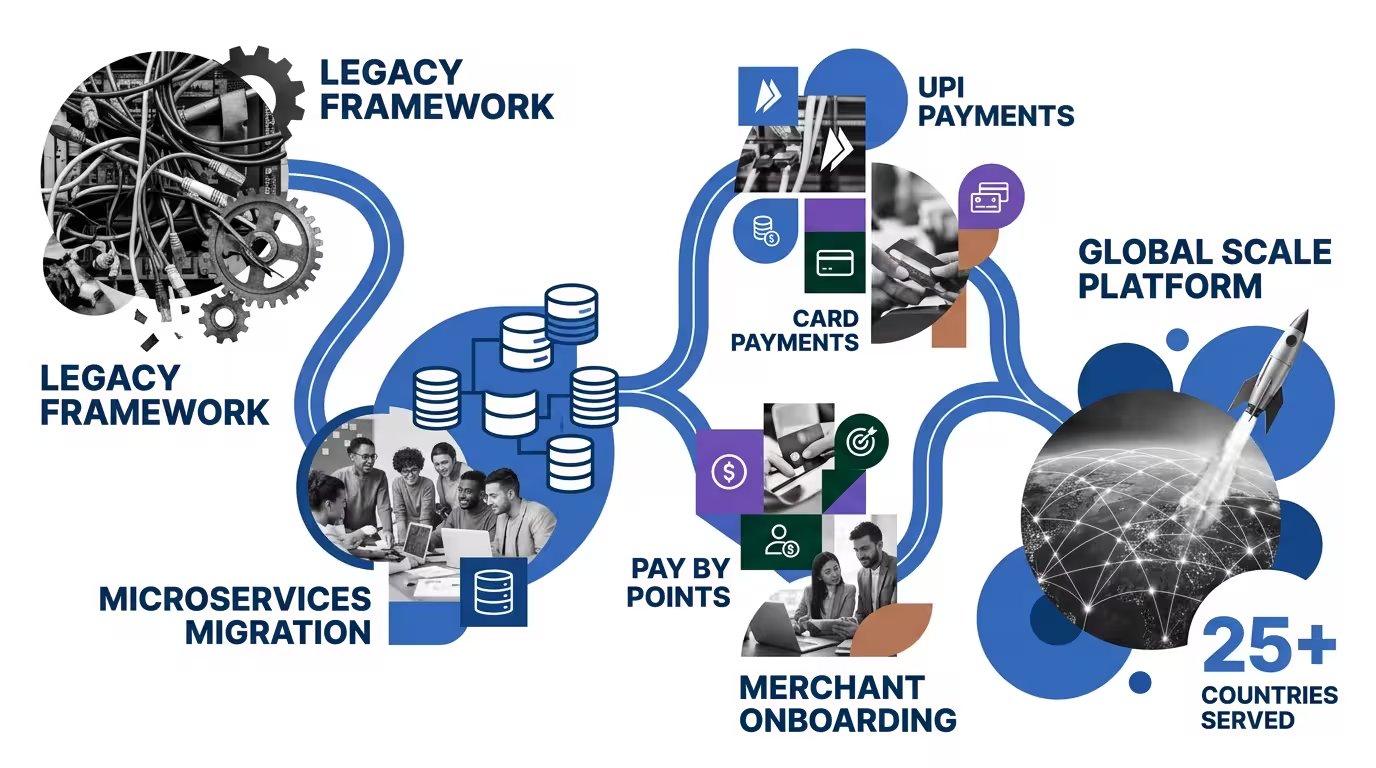
The engagement centred on migrating the existing hybrid Java framework to Kotlin-based microservices. The move towards modular, decoupled services was designed to make individual components easier to maintain, extend and scale as business requirements evolved.
The teams applied clean code and SOLID principles, supported by automated testing, documentation and observability practices. Together, these helped establish a foundation that could accommodate change without introducing unnecessary complexity across the platform.
One of the important capabilities developed during the engagement was Pay by Points.
The client already had a loyalty points system but wanted to make accumulated points usable within its payment offerings. Technogise designed and implemented the Pay by Points integration, connecting loyalty functionality with the broader payment platform and making points another option within the payment journey.
This was a practical example of how the modernisation supported the client's business needs, bringing distinct capabilities together to create a more flexible payment experience.

Alongside Pay by Points, Technogise worked on integrating UPI payments with the acquirer system and supporting card and wallet payments.
These capabilities were developed within a unified platform that also supported reporting. Bringing different payment methods together created a more cohesive experience while establishing a modular foundation for further development.
Payment capabilities were only one part of the engagement. For merchants, the experience of joining and using the platform mattered just as much.
Technogise developed an end-to-end merchant onboarding system to simplify the process of bringing new merchants onto the platform. The team also built a merchant dashboard that provided real-time transaction visualisation, giving stakeholders a central view of payment activity.
Together, these capabilities addressed two practical operational needs: making it easier for merchants to get started and improving visibility into the transactions flowing through the ecosystem.

The breadth of the engagement called for collaboration across several engineering workstreams. Technogise's cross-functional teams worked alongside the client's in-house developers across Pune and Bengaluru, contributing to core platform development, payment integrations, loyalty functionality, merchant onboarding and reporting.
Some workstreams, including Pay by Points and merchant onboarding, were led by dedicated Technogise teams. Others, such as UPI integration, card payments and the merchant dashboard, involved blended teams from both organisations. This approach combined focused ownership of individual capabilities with close collaboration across the wider platform.
Documentation, automated testing and knowledge sharing were important parts of delivery, helping the client's teams understand the evolving architecture and build the capability to maintain and extend it independently. The engagement was therefore not limited to delivering production-ready functionality. It also involved establishing engineering practices and shared understanding that could support the platform beyond the initial project.
Over the course of the year, Technogise and the client's teams delivered a modernised technology platform alongside several production-ready payment and merchant-facing capabilities.
A payment platform's strength lies not only in the transactions it processes, but also in how easily it can adapt as business needs change.
For this fintech organisation, modernisation meant bringing together capabilities that served different parts of the payment journey while strengthening the technology beneath them. By combining architectural modernisation, payment integrations, merchant-facing development and collaborative engineering, Technogise helped create a more connected and adaptable platform, better equipped for the opportunities ahead.